

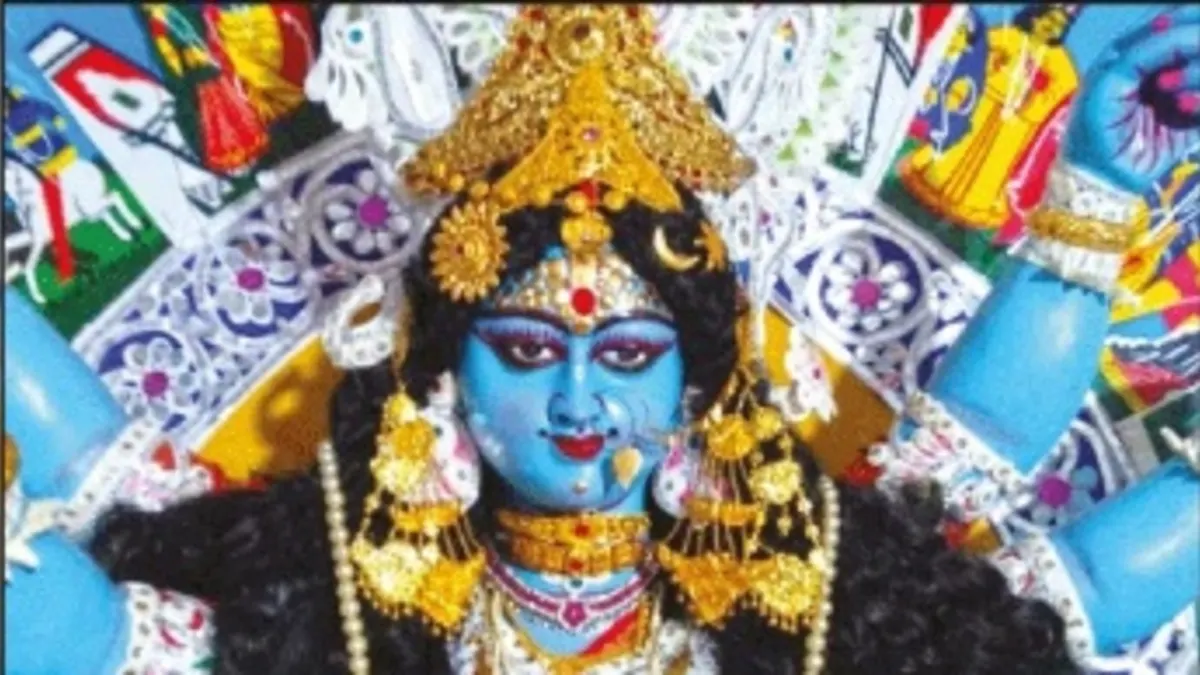
ASANSOL. The Chatterjee family of Nazirapara in the Nadia district headquarters of Krishnanagar has been worshipping a blue-colored Goddess Durga for 350 years. It is popularly known as 'Adi Neel Durgabadi'. Old beliefs and age-old customs are still maintained today. On Dashami, before bidding farewell to the Goddess, people eat panta bhat (fermented rice), taro (kachu) curry, lentil vadas, and Gandharaj lemon.
The worship was originally started by Chintaharan Chatterjee in Bamrail village of Barisal district in undivided Bengal. After partition, the Chatterjee family moved to Krishnanagar. Earlier, the skin tone of the Goddess was dark brown. According to claims, one year a sculptor was painting the idol at night during a storm. After working all night, in the dawn light, he saw that the skin tone of the Goddess had turned blue like the Aparajita flower. Chintaharan, the head of the family, said that the Goddess had ordered him in a dream to worship her in blue. Following this, the worship of the blue Durga began. According to family members, the worship is performed at home with an 'ekchala' idol. The positions of Ganesha and Kartikeya are swapped. Earlier, animal sacrifice of a goat was performed on the seventh, eighth, and ninth days. Now, sugarcane and bananas are sacrificed. In Bangladesh, there was a custom of buffalo sacrifice. After its discontinuation, the person in charge of the puja cuts his hand to offer blood. The worship of the Mother is performed in a reverse manner, and on the sixth day, the bel tree at home is worshipped. The rituals follow Shakta traditions. On the seventh, eighth, and ninth days, fiber-rich food is offered to the Mother. On the tenth day, panta bhat, lentil vadas, and taro greens are offered. Rice powder mixed with pituli on banana leaves is shaped into a human form and offered as a symbolic sacrifice.