
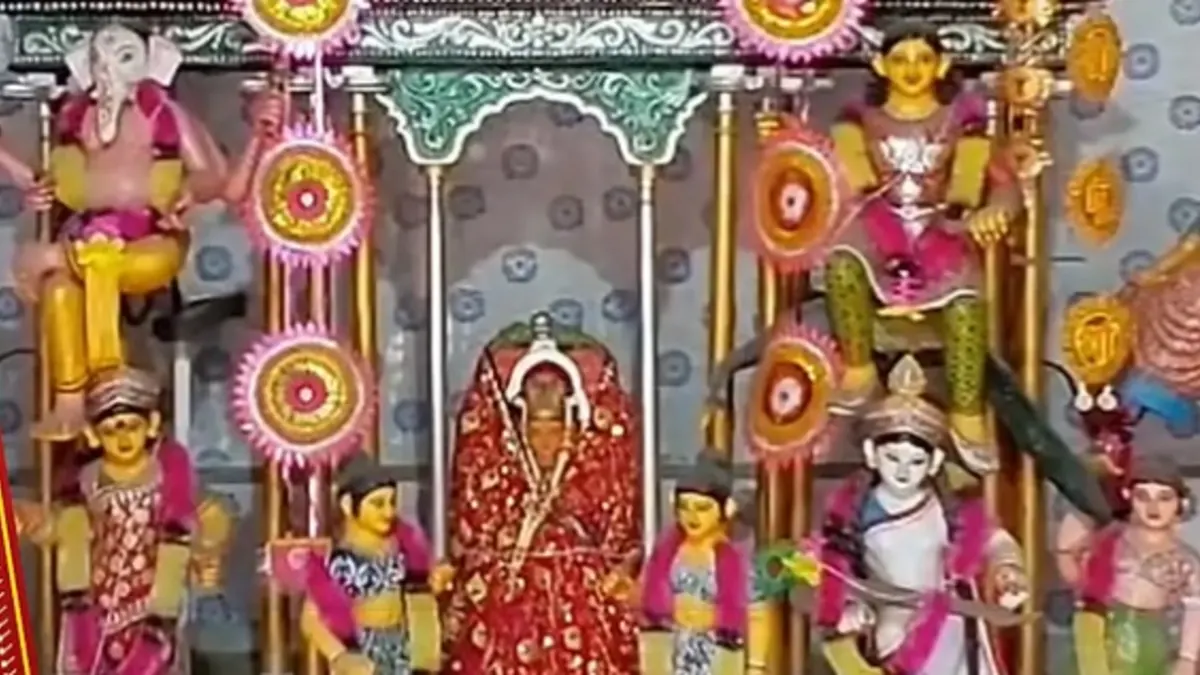
Asansol. Durga Puja began 300 years ago following a divine message received in a dream. The Chowdhury family of Damodarbati village in Onda, Bankura district, has been worshipping according to tradition and customs. This year too, members of the Chowdhury family are busy with the worship of the goddess. Their ancestor, Damodar Narayan, was driven out of Jessore in present-day Bangladesh and took refuge under the Malla kings of Bishnupur.
Damodar began taking care of their taluk. Seeing his work, the Malla kings paid attention to him and also gave him several pieces of land. They settled there with their family and later became famous as landlords in the area. Current family member Parthapratim Chowdhury said that the Malla kings had given Damodar Narayan the title of Chowdhury, and later the village was named Damodarbati after him. Afterwards, following a divine message in a dream, they brought a floating neem tree from the river, made an idol in the style of Bishnupur clay idols, and started the worship. Since then, Durga Puja started in the Chowdhury family. However, unlike other landlord households where the idol is removed after the puja, the rule of this house is completely different. Here, Goddess Durga is worshipped daily as the family deity (Kuldevi). However, the busyness increases even more during the four days of puja. Family member Shampali Chowdhury said that continuing the old tradition, 'nahawat' takes place twice a day in the house from the day after Mahalaya, and the goddess is worshipped on Panchami and Shashthi. On Saptami, the Ghat of worship is brought in a palanquin, and on Saptami, Ashtami, and Navami, sugarcane and 'chakumdo' (ash gourd) are sacrificed. Along with completely Vaishnavite worship, Chandi path written on palm leaves is also performed during the puja. Although the Chowdhury family has their own puja, local people know this puja as 'Barh Mela'. Even though the landlord's grandeur may have decreased, the family members leave no stone unturned in the worship. People from every section of the area still participate in the Chowdhury family's puja in the same way. Strictly speaking, members of the Chowdhury family, wherever they live, remain present for the home worship during the days of the puja.