

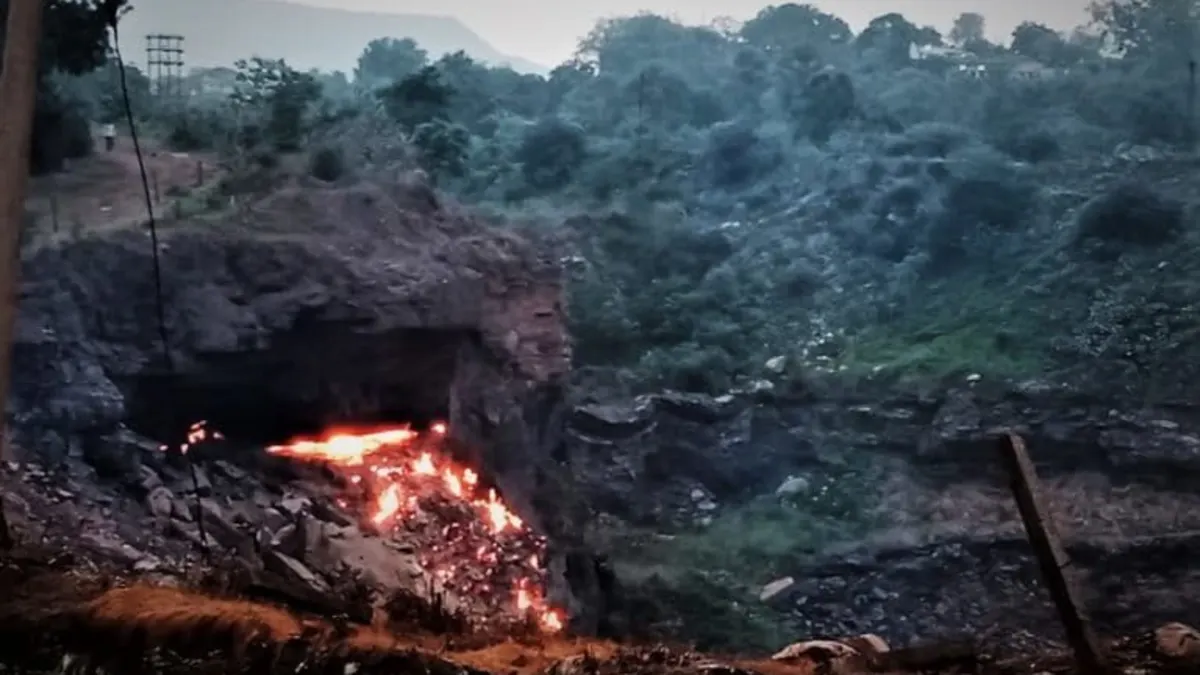
Dhanbad: A vast expanse of the Jharia colliery region has long been plagued by underground fires and land subsidence. To combat this critical challenge, the central government approved the Jharia Action Plan in 2009. Originally estimated at Rs 7,112 crore, the 12-year project aimed to complete designated mitigation works. However, keeping in view the evolving needs of the affected population, the Jharia Action Plan was revised, receiving central government approval in June 2025.
Valued at Rs 5,940 crore, the revised plan sets a completion target of December 2028. Following this revision, the cumulative cost of the Jharia Action Plan has escalated from Rs 7,112 crore to Rs 13,052 crore.
The initial phase of the Jharia Action Plan primarily outlined two key objectives: first, containing the underground fire sites, and second, relocating residents from the vulnerable zone to new housing under the rehabilitation scheme.
According to official data, there were 77 fire-affected zones in the Jharia colliery region in 1972-73. The deployment of modern technologies to douse the coal seam fires has successfully reduced the number of active fire zones to just seven. Consequently, the fire-affected area has shrunk from 8.9 square kilometers to a mere 1.8 square kilometers. These remaining seven zones are targeted for complete containment by December 2027. This means that post-December 2027, no part of the Jharia colliery region will harbor underground coal fires.
To safely resettle residents from fire and subsidence-prone areas, 32,049 new houses have been constructed under the rehabilitation scheme. Yet, only 7,334 families have been relocated to these dwellings thus far. The central government believes that ongoing economic activities within the colliery area make residents reluctant to benefit from the rehabilitation initiative. Nevertheless, the administration has developed all essential basic infrastructure at the resettlement sites, including skill development centers, hospitals, and schools.
A total of 1,130 families residing in the Jharia colliery area laid claim to the land they currently inhabit. Scrutiny revealed that only 172 of these families possess valid land documents, while the remaining 958 claimants lack legitimate paperwork. Families with valid documentation are categorized under LTH (Legal Title Holder), while those without documents fall into the NLTH (Non-Legal Title Holder) category. However, under the revised action plan, both categories of beneficiaries are entitled to equal benefits under the rehabilitation scheme.
Previously, disparities existed in the facilities extended to beneficiaries of these two categories, but the rules have now been amended. Per the BCCL (Bharat Coking Coal Limited) board's decision, beneficiaries will no longer be required to pay stamp duty and registration fees during the housing lease process. BCCL will lease this land to the Jharia Rehabilitation and Development Authority (JRDA), which in turn will lease the houses to the beneficiaries at a nominal fee.
By December 2026, the target is to relocate 3,691 families from the Lodna and Bastacolla areas. Among these targeted families slated for shifting, only 51 possess valid land documents.